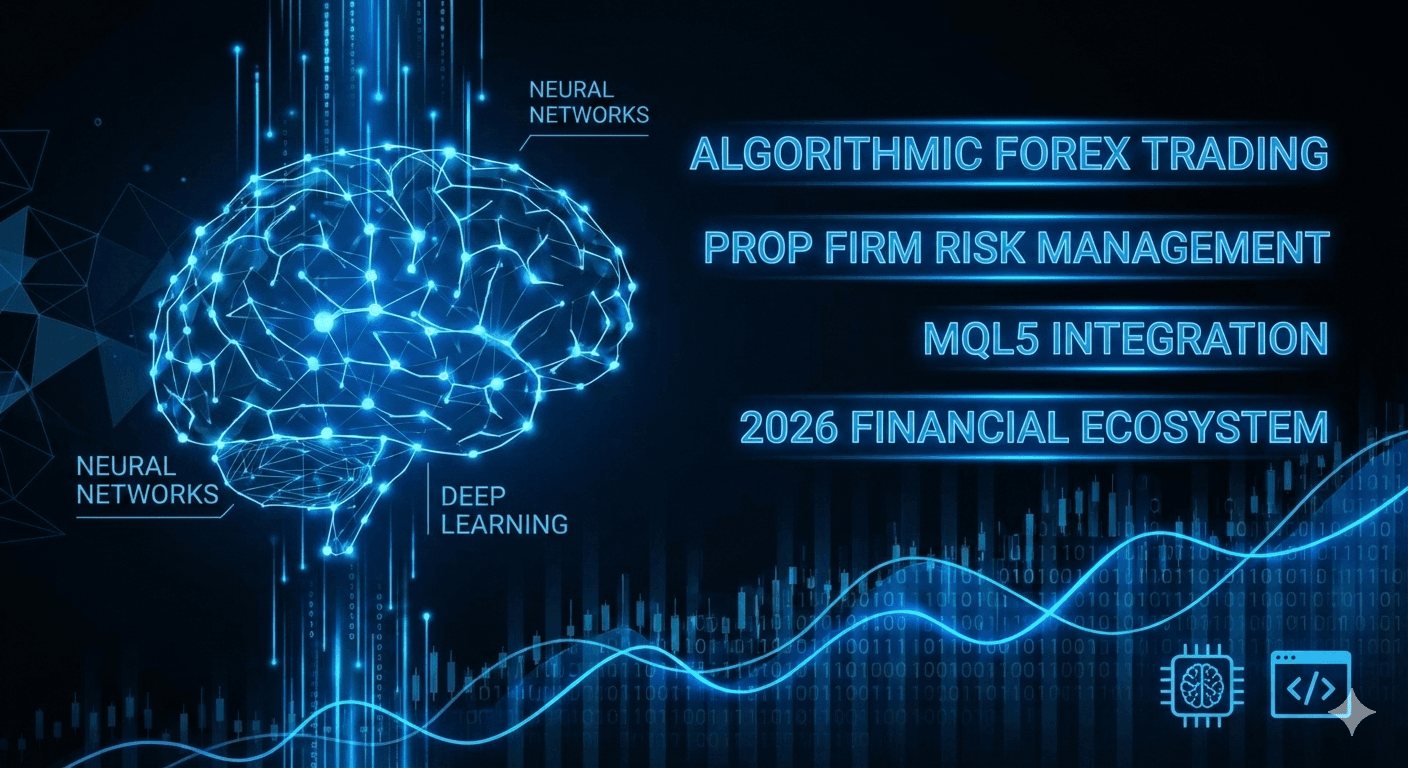
Image source; Freepik
Check out our professional AI Trading Algorithms at Auron Automations or the MQL5 Marketplace
Introduction: The Silicon Revolution in Financial Markets
The transformation of global financial markets from human-centric trading floors to silicon-based automated ecosystems represents one of the most significant shifts in economic history. Algorithmic trading, commonly referred to as "algo trading," leverages computer programs to execute orders based on pre-programmed instructions accounting for variables such as timing, price, and volume. By 2026, this methodology has moved beyond the specialized domain of institutional high-frequency firms to become a cornerstone of the broader investment landscape, fueled by the democratization of high-performance computing and the integration of advanced artificial intelligence.
The fundamental objective remains the optimization of execution speed and the elimination of human emotional biases—such as fear and greed—which frequently compromise manual decision-making. With the global algorithmic trading market projected to reach $25.04 billion in 2026, growing at a compound annual rate of 14.4%, understanding this technology has become essential for modern investors.
Market Dynamics and Search Interest in 2026
The search interest in algorithmic trading and its associated technologies reflects a burgeoning interest in automated solutions. Data from the 2025-2026 period indicates a significant surge in queries related to "ai for stock trading" and "best ai for stock trading," which saw increases of up to 200%. This trend suggests a market pivot toward "ai tools for stock trading" and "ai day trading," as retail and institutional participants alike seek to navigate the volatility of a technology-heavy market.
Search Query | Search Interest | Increase Percent | Implied Strategic Shift |
|---|---|---|---|
ai tools for stock trading | 14 | 1,000% | Demand for integrated toolsets |
stock market news | 13 | 3,700% | Volatility-driven information needs |
nvidia stock | 15 | 170% | Single-stock focus for automated volatility |
quantitative trading | 27 | 40% | Professionalization of retail strategies |
algorithmic trading python | 47 | 10% | Language-specific skill acquisition |
This landscape indicates that "algo trading" is no longer an isolated technical term but a multifaceted industry encompassing "algorithmic crypto trading," "algorithmic options trading," and "algorithmic energy trading."
Foundational Classifications: Algorithmic, Quantitative, and Systematic Trading
To navigate the field effectively, one must distinguish between three overlapping yet distinct disciplines:
Algorithmic Trading
Algorithmic trading focuses primarily on the execution of trades—the "how" of the transaction—aiming to reduce transaction costs and minimize market impact through intelligent order slicing. This involves breaking large orders into smaller pieces to avoid moving the market against the trader's position.
Quantitative Trading
In contrast, quantitative trading (or "quant" trading) is the study of the "what"—utilizing mathematical and statistical models to identify patterns, trends, and anomalies in data to uncover tradable insights. This approach relies heavily on historical data analysis and statistical modeling.
Systematic Trading
Systematic trading serves as the bridge, providing an organized framework that integrates quantitative models into an automated, rules-based engine to ensure disciplined capital allocation. This removes human discretion from the trading process once the system is deployed.
The core concept behind these systems is the removal of human intervention in the execution phase. This enables traders to react instantly to fleeting market changes, capitalizing on opportunities that exist for only milliseconds. By 2026, the convergence of these fields has led to "quantamental" trading, which blends human intuition and fundamental research with the mathematical rigor of machine learning models.
Strategy Archetypes and Execution Methodologies
The strategies deployed in 2026 vary in complexity, from basic trend-following logic to sophisticated statistical arbitrage. These strategies are often classified by their frequency (high vs. low) and their underlying objective (alpha generation vs. execution optimization).
Trend Following and Momentum
Trend following remains a primary strategy, utilizing moving averages, channel breakouts, and indicators like the RSI or Bollinger Bands to identify directional shifts. In 2026, momentum strategies have become increasingly adaptive, utilizing "regime detection" to distinguish between range-bound markets and true directional breakouts.
Strategy Type | Typical Win Rate | Primary Objective | Key Indicators |
|---|---|---|---|
Trend Following | 45% - 55% | Capturing long-term price waves | Moving Averages, ADX |
Mean Reversion | 55% - 75% | Profiting from overextended prices | Bollinger Bands, RSI |
Statistical Arbitrage | 50% - 65% | Capitalizing on asset correlations | Co-integration, Pairs ratios |
Market Making | High | Capturing the Bid-Ask spread | Order flow, Volume profile |
Mean Reversion and Convergence Trading
Mean reversion assumes that asset prices will eventually revert to their historical average. In 2026, these models often incorporate "VIX-related" volatility filters and "Z-score" deviations to prevent the algorithm from buying a "falling knife" during severe market shocks. The primary risk is the "whipsaw"—a situation where the market fluctuates rapidly, triggering stop-losses before the expected reversion occurs.
Arbitrage and Market Neutrality
Arbitrage strategies seek to exploit price discrepancies across different markets (spatial arbitrage), timeframes (futures vs. spot arbitrage), or currency loops (triangular arbitrage). Because these trades involve simultaneous buy and sell orders, they are inherently market-neutral, making them attractive during periods of high geopolitical uncertainty.
The Artificial Intelligence Revolution in Strategy Development
By 2026, the role of Artificial Intelligence (AI) and Machine Learning (ML) has shifted from experimental to foundational. Advanced tools now process "alternative data," such as satellite imagery, sentiment from social media, and automated earnings call transcripts, to find alpha that traditional metrics miss.
Advances in Financial Machine Learning (AFML)
The methodology proposed by Marcos López de Prado emphasizes that financial ML is a distinct subject from traditional data science. Key concepts adopted by the industry include:
- •
The Triple-Barrier Method: A labeling technique that sets profit-taking, stop-loss, and time-out barriers for every data point, capturing the price path rather than just the final return.
- •
Meta-Labeling: Using a primary model to decide the side of the trade (buy/sell) and a secondary model to decide the "bet size", significantly improving risk-adjusted returns.
- •
Fractional Differentiation: A method of achieving stationarity in price data without removing the "memory" of the series, which traditional integer differentiation often destroys.
- •
Purged K-fold Cross-Validation: A validation technique that removes training data points that overlap with test data, preventing "lookahead bias" and overfitting.
Generative AI and Large Language Models (LLMs)
In 2026, LLMs such as Claude 4.5, GPT-5.2, and Gemini have become essential "coding assistants" for strategy generation. These models can translate abstract trading ideas into executable Pine Script or Python code, allowing even non-technical traders to build complex automated systems.
- •
NexusTrade and Composer: These platforms allow users to use "natural language" prompts to create strategies, which the system then backtests and deploys.
- •
Claude Code and OpenAI Codex: These models excel at "Terminal-based workflows" and refactoring large codebases, helping developers manage multi-file trading systems with ease.
- •
Perplexity AI: Used extensively for real-time market research, providing cited summaries of macro trends and earnings reports from Bloomberg, WSJ, and CNBC.
Programming Languages and the Technical Ecosystem
The 2026 technological stack is optimized for both development flexibility and execution speed. Python remains the dominant language for research, while C++ and Rust are preferred for latency-sensitive components.
The Python Quant Toolkit
Python's success is rooted in its extensive library ecosystem. Key libraries utilized by quantitative professionals include:
- •
NumPy and Pandas: Essential for handling multi-dimensional arrays and time-series data like OHLC (Open, High, Low, Close) price bars.
- •
TA-Lib: A library containing over 150 technical indicators, ensuring precise and standardized calculations.
- •
Zipline and Backtrader: Event-driven backtesting engines that simulate real-world trading conditions, including slippage and transaction costs.
- •
QuantLib: A powerful library for derivatives pricing, risk management, and Monte Carlo simulations.
- •
Statsmodels: Used for uncovering market cycles through ARIMA models and validating correlations between assets.
Tool/Library | Primary Function | Ideal Application |
|---|---|---|
Pandas | Time-series manipulation | Data cleaning and resampling |
Scikit-learn | Supervised Learning | Predicting returns via Random Forests |
PyMC3 | Bayesian Statistics | Stochastic volatility modeling |
QSTrader | Event-driven backtesting | Institutional-grade strategy testing |
Matplotlib/Plotly | Data Visualization | Interactive equity curve analysis |
Infrastructure: Latency, Colocation, and Hardware Acceleration
Infrastructure is the "engine room" of algorithmic trading. In the HFT world, milliseconds are equivalent to millions in potential profit or loss.
Low-Latency Connectivity and Colocation
Colocation involves placing trading servers inside the exchange's data center (e.g., Equinix LD4 in London or NY4 in New Jersey). This proximity allows orders to reach the matching engine in microseconds rather than milliseconds. For retail traders, a specialized "Trading VPS" (Virtual Private Server) provides a middle ground, offering low-latency connections and 24/7 operation regardless of local power or internet conditions.
VPS Tier | vCPU/RAM Specs | Typical Cost | Latency to CME/NYSE |
|---|---|---|---|
Budget | 2 vCPU / 4GB RAM | 20/mo | 1ms - 5ms |
Standard | 3 vCPU / 8GB RAM | 75/mo | < 1ms |
Professional | 4+ vCPU / 16GB RAM | $130+/mo | Sub-1ms |
Hardware Acceleration: FPGA vs. GPU vs. ASIC
As algorithms become more complex, traditional CPUs often become bottlenecks. 2026 trends show an increasing reliance on hardware accelerators:
- •
GPUs (Graphics Processing Units): Dominate tasks requiring high parallelization, such as training neural networks or processing massive datasets for sentiment analysis.
- •
FPGAs (Field-Programmable Gate Arrays): Highly flexible, reconfigurable chips that allow traders to "bake" their logic directly into the hardware, offering lower latency than GPUs for sequential trading logic.
- •
ASICs (Application-Specific Integrated Circuits): Custom-built chips designed for a single task. While they offer the highest efficiency and lowest power consumption, they lack the flexibility needed for evolving trading strategies.
The Platform Landscape: Brokers and Software for 2026
The algorithmic trading platform market has evolved to serve different segments, from beginner retail traders to institutional quants.
Top-Rated Brokers and API Platforms
- •
Alpaca: Recognized as the "Best Broker for Algorithmic Trading in 2026" by BrokerChooser, Alpaca offers commission-free API access to stocks, ETFs, crypto, and options. Its "developer-first approach" and integrations with TradingView and Slack have lowered the entry barrier for millions of traders.
- •
Interactive Brokers (IBKR): A mainstay for professional traders, providing access to over 100 markets globally and supporting a vast range of asset classes including futures and bonds.
- •
QuantConnect: An open-source, cloud-based platform that supports multi-language coding and provides institutional-grade market data for researchers.
Specialized AI Trading Software
App/Platform | Ideal User | Focus Area | Pricing Model |
|---|---|---|---|
Trade Ideas (Holly) | Day Traders | Real-time scanners & AI signals | 254/mo |
TrendSpider | Technical Analysts | Automated trendlines & Heatmaps | Starts at $82/mo |
Tickeron | Swing Traders | Pattern recognition & Trading bots | Up to $250/mo |
AlgosOne | Hands-off Investors | DCA and Grid automation bots | Performance fee model |
ChainGPT | Crypto Traders | Sentiment scanning & Web3 logic | Credit-based system |
Risk Management: The Lessons of Knight Capital
No discussion of algorithmic trading is complete without an analysis of the inherent risks. The 2012 Knight Capital Group failure, where a dormant piece of code triggered $440 million in losses in just 45 minutes, serves as the ultimate cautionary tale.
Technical Failures and QA Oversight
The Knight Capital disaster was not caused by market volatility, but by a breakdown in Quality Assurance (QA). Developers updated only 7 out of 8 servers with new code, leaving the eighth server to execute trades based on a retired function called "Power Peg". This rogue server launched millions of automated trades at market rates with zero restraint, executing 397 million shares across 154 stocks before humans could intervene.
Best Practices for Risk Frameworks in 2026
Modern institutional and retail frameworks now incorporate multi-layered "circuit breakers" and governance rules:
- •
Kill Switches: Mechanisms that immediately suspend all trading if specific loss thresholds or message-volume limits are breached.
- •
Position Caps and Drawdown Pauses: Predetermined limits that automatically stop an algorithm from adding to a losing position.
- •
Auditability and Version Control: Strict requirements to record who owned and approved every piece of code, preventing unreviewed "rogue" modules from reaching production.
- •
The "One Big Loss" Filter: Hard stops and time-in-trade limits are particularly critical for mean reversion strategies, which can otherwise suffer "death by a thousand cuts" during a major market breakout.
Advantages and Disadvantages of Algorithmic Trading
The transition from manual to algorithmic trading is a strategic choice involving trade-offs between efficiency and technological risk.
Advantages
- •
Speed and Execution: Orders are placed the instant conditions are met, capturing fleeting opportunities inaccessible to humans.
- •
Discipline: Algorithms follow logic and data, removing the emotional "bull market frenzy" or panic-selling that often ruins portfolios.
- •
Scalability: A single system can manage multiple markets (Forex, Equities, Crypto, Energy) and strategies simultaneously.
- •
Cost Efficiency: Minimizes market impact by slicing large orders and reducing operational overhead through automation.
Disadvantages
- •
Technical Barrier: Requires significant knowledge of both programming (Python/C++) and market mechanics.
- •
Systemic Risk: Glitches can lead to "Flash Crashes" or massive financial losses in minutes.
- •
Strategy Decay: As successful patterns become public, more capital chases the same "edge," trading away the alpha until the strategy becomes ineffective.
- •
Over-Optimization: The risk of "curve-fitting" historical data, leading to a system that looks great in the past but fails in the unpredictable future.
Mathematical Foundations and Key Formulas
Understanding the mathematical foundations is crucial for implementing effective algorithmic trading strategies. Here are some key formulas used in quantitative finance:
Sharpe Ratio
The Sharpe ratio measures risk-adjusted returns:
Where is the portfolio return, is the risk-free rate, and is the standard deviation of portfolio returns.
Value at Risk (VaR)
VaR estimates the maximum potential loss over a specific time period:
Where is the expected return, is the z-score for confidence level , and is the standard deviation.
Black-Scholes Model
For options pricing in algorithmic strategies:
Where is the call option price, is the current stock price, is the strike price, is the risk-free rate, is time to expiration, and is the cumulative standard normal distribution.
Educational Pathways: Professionalizing the Trade
By 2026, the demand for formal education in algorithmic trading has skyrocketed. The Oxford Algorithmic Trading Programme serves as a benchmark, providing a six-week interdisciplinary path covering financial theory, behavioral finance, and the "why" of AI regulation. The curriculum emphasizes that identifying patterns is only the first step; building an institutional-grade model requires a "production chain" of specialists: data curators, feature analysts, strategists, and deployment teams.
Conclusion: The Strategic Horizon of 2026
Algorithmic trading has fundamentally redefined the relationship between humans and technology in the financial industry. By 2026, the "engine rooms" of the market are no longer filled with bustling traders, but with highly interactive "market ecologies" of competing algorithms. For the professional trader, success now depends on the ability to architect systems that are both fast and robust, utilizing machine learning to adapt to a world where market complexity is exploding.
While the barriers to entry have lowered for retail participants through API-driven platforms like Alpaca and Interactive Brokers, the "arms race" for speed and alpha has only intensified at the institutional level. The integration of AI for stock trading and advanced Python libraries has democratized access to sophisticated trading strategies, but success still requires deep understanding of both technology and market dynamics.
In this environment, algorithmic trading is not merely a tool for efficiency—it is the essential infrastructure required to navigate the high-speed, data-driven reality of modern finance. Whether you're implementing algorithmic trading strategies in Python, exploring algorithmic crypto trading, or building sophisticated quantitative trading models, the future belongs to those who can successfully merge human insight with machine precision.
References
What is Algorithmic Trading - Meaning | Types | Pros & Cons - The IoT Academy
Why 2026 Will Be The Year Algorithmic Trading Goes Mainstream
Algorithmic Trading: Pros, Cons, and Cutting-Edge Developments
Algorithmic Trading: What Is It, Examples, & Algo Trading Strategies | Gemini
Algorithmic Trading Market Report 2026, Size And Analysis By 2035
Quantitative vs Algorithmic Trading: Definition & Differences | Intrinio
Quantitative Trading: Everything You Need to Know | IG International
Systematic Trading: Strategies, Concepts & Quantitative Approach - QuantInsti
Advances in Financial Machine Learning · Reasonable Deviations
Algorithmic Trading Strategies: Guide to Automated Trading in 2026 - ThinkMarkets
12 Best Algorithmic Trading Strategies to Know in 2026 - Snap Innovations
I used OpenAI's GPT 4.5 to create a trading strategy - Reddit
I gave Claude Code 100k to trade with for a month | by Jake Nesler
Popular Python Libraries for Algorithmic Trading – Part I - Interactive Brokers
How to Build a Low-Latency Trading Infrastructure (in 6 Steps) - ForexVPS
Best VPS for Algorithmic Trading: Top Low-Latency Servers | QuantVPS
Hardware Acceleration Market Size & Growth Forecast, 2032 - SNS Insider
FPGA vs. ASIC vs. GPU: Which is the Right Choice for Your Project? - Kynix
Alpaca Recognized as "Best Broker for Algorithmic Trading in 2026"
When Software Goes Unchecked: Financial Giant Knight Capital Nearly Ruined - Qeedio
Preventing the Next Knightmare: How Robust QA Could Have Saved $440 Million
The Rise of Quant Power Trading: Data, Algorithms and Speed - Montel